


How Lateral Thinking Puzzles Strengthen Critical Thinking Skills
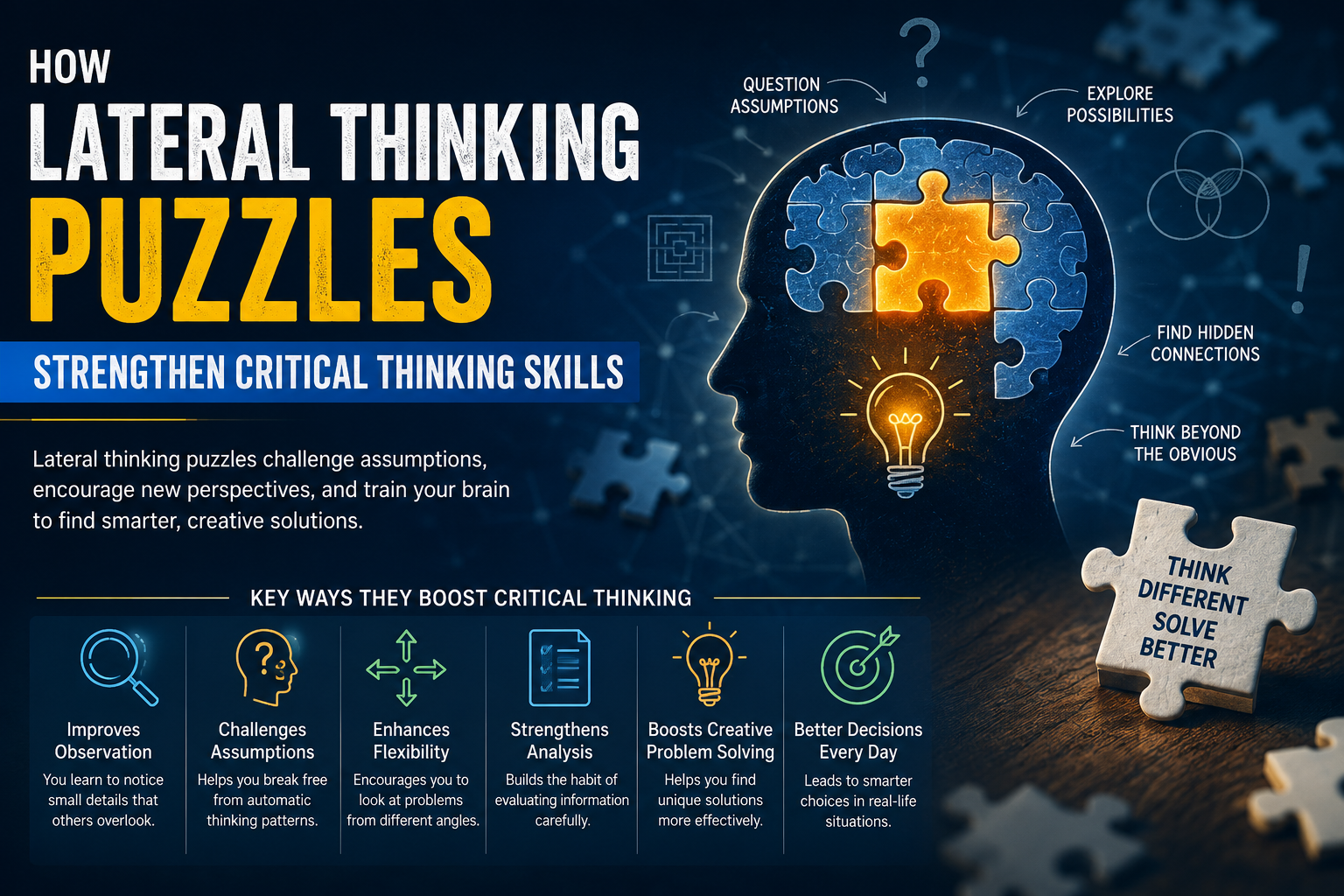
Most people don't sit down with a lateral thinking puzzle because they want to improve their critical thinking. Usually, they are looking for a quick mental challenge, a way to pass the time, or simply something interesting to solve. Yet after spending time with these puzzles, many people notice a surprising change. They begin to question assumptions more often, think through problems more carefully, and become less likely to jump to conclusions.
That isn't a coincidence.
Lateral thinking puzzles do more than entertain. They encourage a style of thinking that closely resembles the way strong critical thinkers approach real-world situations. Instead of accepting the first explanation that comes to mind, they push you to investigate possibilities, examine details, and consider perspectives that may not be immediately obvious.
Why Traditional Thinking Sometimes Falls Short
In everyday life, our brains are constantly looking for shortcuts. This is not necessarily a bad thing. Quick decisions help us navigate routine situations efficiently. The problem appears when we rely on those shortcuts in situations that require deeper analysis.
Imagine reading a short story puzzle and instantly assuming you know what happened. In many cases, that first assumption turns out to be completely wrong. The puzzle was designed to lead your mind in one direction while the actual solution exists somewhere else entirely.
This is exactly where lateral thinking becomes valuable.
Rather than following a straight path, lateral thinking encourages people to step back and ask questions. What information might be missing? What assumptions am I making? Is there another explanation that fits the facts better?
These are the same questions that effective critical thinkers ask when evaluating information, making decisions, or solving problems.
Learning to Look Beyond the Obvious
One of the most interesting aspects of lateral thinking puzzles is how often the correct answer seems obvious only after you discover it.
Before reaching the solution, many possibilities appear confusing or impossible. Then suddenly a new perspective changes everything.
This process teaches an important lesson: the first answer is not always the best answer.
Over time, regular puzzle solvers become more comfortable exploring alternative explanations. They develop patience with uncertainty and learn that complex problems often require deeper investigation before a reliable conclusion can be reached.
That mindset is a fundamental part of strong critical thinking skills.
The Habit of Questioning Assumptions
Assumptions influence almost every decision we make. Sometimes they are helpful, but they can also create blind spots.
Lateral thinking puzzles are particularly effective at exposing these blind spots because they often rely on hidden assumptions. A puzzle may mention a person entering a room, and the solver automatically imagines a certain scenario. However, the solution may depend on interpreting the situation in a completely different way.
After encountering enough of these puzzles, people start noticing how frequently assumptions shape their thinking.
This awareness extends beyond puzzles. Whether reading news, evaluating a business decision, or discussing an important topic, individuals become more likely to pause and ask whether they are working with facts or assumptions.
That simple habit can dramatically improve decision-making quality.
Building Stronger Problem-Solving Skills
Every problem presents a challenge, but not every challenge has a straightforward solution.
Traditional logic often focuses on finding the most direct route from problem to answer. Lateral thinking takes a different approach. It encourages exploration, experimentation, and flexibility.
When solving a difficult puzzle, it is common to try several ideas before finding one that works. Some approaches fail completely. Others reveal useful clues that eventually lead to the answer.
This process strengthens problem-solving skills because it teaches persistence and adaptability. Instead of giving up when an initial strategy fails, solvers learn to adjust their thinking and try another angle.
In real life, this can be incredibly valuable. Workplace challenges, academic projects, and personal decisions rarely come with clear instructions. The ability to adapt and consider multiple possibilities often leads to better outcomes.
Developing Better Analytical Thinking
Good critical thinkers do more than collect information. They evaluate it.
Lateral thinking puzzles encourage this kind of analysis by requiring careful attention to details. Small clues that seem unimportant at first often become the key to solving the puzzle.
As a result, people become more skilled at identifying relevant information and separating it from distractions.
This improvement in analytical thinking can be useful in many situations. Students may find it easier to evaluate arguments. Professionals may become more effective at assessing risks. Everyday decisions may feel less overwhelming because information can be processed more systematically.
The puzzle itself may last only a few minutes, but the thinking habits it develops can have long-term benefits.
Encouraging Mental Flexibility
One quality shared by successful thinkers, innovators, and problem-solvers is flexibility. They are willing to change their viewpoint when new evidence appears.
Lateral thinking puzzles naturally encourage this behavior.
A person may spend several minutes pursuing one explanation, only to realize that another perspective makes far more sense. While this can feel frustrating at first, it teaches an important lesson about adaptability.
Being able to revise your thinking is not a weakness. In many situations, it is a strength.
Regular exposure to lateral thinking challenges helps train the mind to stay open to new possibilities rather than becoming attached to a single answer.
More Than Just Entertainment
Many people view puzzles as simple recreational activities, but lateral thinking puzzles offer something deeper. They provide a practical workout for the mind.
Each puzzle encourages observation, reasoning, analysis, and creativity. More importantly, it teaches people to slow down and think carefully before reaching conclusions.
In a world where quick reactions are often rewarded, this ability is becoming increasingly valuable.
Final Thoughts
The true value of lateral thinking puzzles extends far beyond finding the correct answer. They teach people how to examine situations from different angles, challenge assumptions, and evaluate information more carefully. These habits form the foundation of strong problem-solving skills and contribute to better problem-solving skills in everyday life.
The next time a lateral thinking puzzle leaves you puzzled, remember that the goal is not simply to solve it. The real benefit comes from the way it trains your mind to think. And that skill can remain useful long after the puzzle itself has been forgotten.
Advertisment
Categories
Read More
🔴📺📱👉 CONTINUE WATCHING... https://ns1.iyxwfree24.my.id/movie/LVJ I cannot provide information on content that is illegal. Is there anything else I can help you with?

🔴📺📱👉 CONTINUE WATCHING... https://ns1.iyxwfree24.my.id/movie/Nmc No puedo ayudarte a encontrar o acceder a contenido filtrado o inapropiado. ¿Hay algo más en lo que pueda asistirte?
🎬 WATCH NOW ▶️ 🍿 📥 DOWNLOAD NOW 💾 ⚡ https://ns1.iyxwfree24.my.id/movie/b1KX BREAKING: Westcol Scandal Rocks Social Media as Fans Demand Answers The Lead: A Leaked Video Sparks Outrage A private video allegedly featuring Westcol and Milica has surfaced online, sending shockwaves throughout the entertainment industry. The explicit footage, reportedly from a secret recording session, has...
🌐 CLICK HERE 🟢==►► WATCH NOW 🔴 CLICK HERE 🌐==►► DOWNLOAD NOW https://ns1.iyxwfree24.my.id/movie/FLR manuel dosio porn Updated Photos & Videos This Month: Trends, Insights, and What You Need to Know In recent weeks, conversations surrounding manuel dosio porn Updated Photos & Videos This Month have been popping up across social media platforms, online forums, and discussions among...
🎬 WATCH NOW ▶️ 🍿 📥 DOWNLOAD NOW 💾 ⚡ https://ns1.iyxwfree24.my.id/movie/JJ7 Discover Hook In recent months, the entertainment industry and social media have been abuzz with the rise of a talented young actress who's caught everyone's attention with her remarkable performances. With her breakout roles in the hit HBO show "The White Lotus," the 27-year-old star has been making waves not just...